

Review: “No One Will Know”

★★★

Eve Sylvester thinks that after meeting her lover’s family in Australia she’s going to be sailing around the world with the man of her dreams. Then a tragic accident turns her life inside out. It leaves her disoriented, broke, alone, basically friendless and this shocking development makes her feel nothing good can ever happen to her again.

The tide seems to turn though, dramatically. Despite being completely unqualified, she’s offered a job as a nanny and ends up on a small island off the coast of Tasmania employed by a very wealthy young couple of shipping magnates. As you’d expect from the title, the job that seems to be too good to be true turns out to be a nightmare.

Complete with a Mrs. Danvers figure, this is another update of the popular Gothic formula dating back to Ann Radcliffe: a damsel in distress has to navigate the mysteries of a remote castle or mansion. In this case, the dwelling comes with a lovely summerhouse. And a yacht. 

While you expect twists and turns in a novel of suspense like No One Will Know, except for the very last one they’re undercut because the heroine is so clueless and naive.  At pretty much every turn, Eve misreads people and situations, and finds herself trapped in misery, lies, threatened with mortal danger.  Most surprising of all, though, is that Eve makes an almost catastrophic mistake when taking a boat out to sea even though she’s supposed to be a fairly seasoned sailor.

Right after that, the book’s momentum takes a massive hit.  The structure changes radically: we switch point of view to someone far less interesting than Eve and plunge into some very long flashbacks.  A secret that has been lurking at the edge of the narrative is explained and it’s not dramatic enough. But that’s just the appetizer for a bigger, more horrible secret that reveals just how despicable and sociopathic the people around Eve really are.  Not quite the gang in Rosemary’s Baby, but close enough.

The author is at her best when she describes the forlorn island and the waters around it, and when she writes about the powerful bond between mothers and their babies. In the end, this novel is both horrifying and heart-warming, and that’s not an easy mix to pull off.

Lev Raphael reviewed crime fiction at The Detroit Free Press for many years. He has taught mystery and suspense fiction at Michigan State University and  mystery writing at numerous writers’ conferences. His suspense novel Assault With a Deadly Lie was a Midwest Book Award nominee.
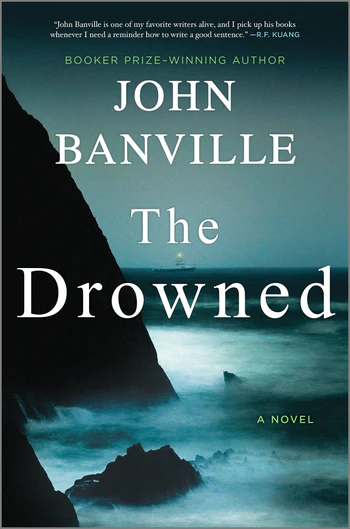


Review: Dark Irish Mystery

★★★★★

Celebrated author John Banville’s latest novel is a slow-burn mystery simmering with secrets, fears, and sins. Almost everyone in it seems a bit off in one way or another, including Detective Inspector Strafford. He’s a fascinating character: brooding, alienated from himself, his feelings, and even the woman he thinks he loves. “It sometimes appeared to Strafford that his life was a series of tableaux as elaborate, studied and unreal as a stage performance at Versailles at the height of the reign of the Sun King.”

The mystery opens in the 1950s with the discovery of a flashy car in the middle of a rural Irish field and a peculiarly calm man claiming that he and his wife have argued, she’s run off and he’s been looking for her. Has she had an accident, committed suicide, or just abandoned him?

At a nearby house where the police are called, the couple renting the place for a week seem to know this man but pretend they don’t. When the local cop shows up, he’s drunk, which adds to the peculiar buzz underlying every word and glance of these people. The mystery fades in and out of view from that point, seeming to parallel a previous mystery Strafford and his pathologist colleague Quirke were involved in. At the end of the novel we find out why that other case lingers here.

Along the way we dive into and out of Strafford’s ambivalent love life and alcoholic Quirke’s profound loneliness. This is where some of the book’s best, most moving prose can be found. And writers who want to polish their dialogue can take a master class from Banville in Chapter 5 where Strafford and his estranged wife have a long conversation that’s quietly nasty and deeply unsettling for both of them. It’s a scene I read twice because it’s so finely crafted. 

There’s also a dazzling, deeply moving foray into the depths of mourning and loneliness which details how badly Quirke is badly coping with the death of his wife. Banville paints the portrait with elegant, moving brush stokes: Quirke feels as “if nothing had happened. The blunt, unceasing continuity of things, baffled him, affronted him. It was a scandal, the entire indifferent business of being alive.”

Equally as fascinating for this American reader, there are many smarky interactions where people recognize with great accuracy each other’s origins and religion based on their accents, something that does not have the charm of anything Henry Higgins sings in My Fair Lady.

Adding to the overall melancholy of the book is the deft description of scenery and the weather which is grim whether the summer has gone on too long or winter rain is pelting down. Physical and emotional atmosphere is everything in this novel.  The Booker Prize-winner is a masterful writer about anything that has been lost.  Here’s how colleagues feel after their boss has died:

“Yet his going left a vast and unfillable absence. It was as if a sacred idol, present for so long that even the attendant priests had ceased to take much notice of it, had been stolen by some sacrilegious vandal, and suddenly the rgeat, glittering temple was reduced to bricks and mortar, and nothing remained of its former sanctity, save a wisp of incense and a gleam of light through one corner of a stained-glass window.”

Lev Raphael is the former crime fiction reviewer for The Detroit Free Press and has reviewed for The Washington Post as well as several Michigan radio stations, one of which aired his interview show. His guests there included Doris Kearns Goodwin, Salman Rushdie, Julian Barnes, and Erica Jong.