Review: Civil War Shock & Awe

★★★★★

Erik Larson is one of our country’s best writers in any genre and one of the few popular historians I regularly re-read.

Whether writing about a historic hurricane in early 19oo’s Galveston or Nazi Berlin in the 1930s, his books are thrilling, evocative, beautifully written, and totally immersive. His level of detail is never excessive but always well-balanced. Every book is a fantastic voyage and his subjects are chosen, he says, for their suspense and a clear beginning, middle, and end. They’re true page turners and you often feel you’ve been transported into the scenes he is sharing.

Larson’s story of the siege of Fort Sumter and the dithering in Washington D.C. about its fate as secession spread through the South is an amazing tale of courage, cowardice, treachery, stupidity, loyalty, lies and propaganda–in sum, a sadly American story.

Relying on contemporary letters, diaries, government reports, speeches, and newspaper stories and editorials, Larson makes you feel like you are in the midst of the rising turmoil in which both sides seem to overestimate their own chances for success.  You come to know President-elect Lincoln and women like the indefatigable diarist Mary Chestnut in new and illuminating ways.  They’re surrounded by myriad schemers, wastrels, fools, incompetents, liars, traitors and cowards–with rare men or women of sense making an appearance anywhere.

And the thread all the way through is the Southern culture of honor and shame. Because so many Northerners believed that slavery was evil and shameful, Southern planters and their kith and kin were humiliated by those feelings, terrified of losing the lifestyle and economy that would collapse without slave labor.  The hysteria in places like Charleston was a heavy miasma, likewise the savage hatred of Yankees.

Larson’s explanation of the weaponry aimed at Fort Sumter and the fortress itself is anything but dry.  You will feel yourself in the thick of the battle. Even more fascinating is his portrait of paranoid, cloistered, provincial South Carolina’s elite who thought of themselves as “the chivalry.”  They believed in fighting duels and quoting poems and novels by Sir Walter Scott as if they were living in another time.  And they were: the rest of the country was expanding railroads and telegraph service while they resisted because such changes could supposedly lead to unrest: slave rebellions.

The book is filled with shocking details like a 9:00 curfew bell ringing in Charleston to make sure that all Black men and women, whether free or slaves, got off the streets and went to their homes wherever they might be. Chivalry, of course, only covered rich white people who lived a life of endless, mindless calling upon another, teas and dinners and horse racing–and politics.  The up side of this was the attack on Fort Sumter which is the main story line: southerners actually at times cheered the bravery of the fort’s commander and his men.

It’s impossible to read this thrilling book that describes such myopic, arrogant, and bigoted participants in the national drama and not think about today’s current cultural and political madness.

Lev Raphael has reviewed books for The Washington Post, The Detroit Free Press and  three different public radio stations in Michigan.
Our Forgotten War

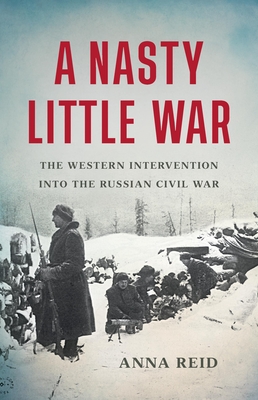
Anna Reid is the author of Borderland, a brilliant book about the history of Ukraine, and she tackles an even more complicated story in A Nasty Little War.

The Allies in WWI were under the delusional belief that they could intervene in Russia’s civil war, invade the country after the 1917 Bolshevik Revolution and Russia’s peace treaty with Germany, and force it back into the war and/or crush the Bolsheviks. Armies from more than a dozen countries landed in Russia’s Far East, in the Caucasus, and the frozen north near Finland. They fought a dizzying array of armies, supported over a dozen different governments, ignored the massacres of Jews as well as mass executions, and believed that they were making Russia great again. Or at least harmless.

Arrogance, lack of information and insight, shambolic planning, bigotry, and theft of supplies undermined the campaigns at almost every step. One of the most ludicrous examples of stupidity among many falls to President Wilson. He initially sent troops from Michigan and Wisconsin to Russia’s subarctic Murmansk and Archangel because it was believed they would be used to the cold. 

If there wasn’t so much cruelty, confusion, death and and combat, you might think the months of political and military wheel spinning had been organized by Monty Python’s Flying Circus. Even when nearly 200,000 troops were on the ground across the vast country, they made very little impact.  The only real success was establishing Red Cross hospitals which had never been a war aim and some treaty agreements for the newly-independent Latvia and Estonia.

The vivid and engrossing book is enlivened by quotations from letters and diaries and many of them from the Allied side are stunning in their crudity.  Churchill as Minister of Munitions thought that Russia was “a very disagreeable country, inhabited by immense numbers of ignorant people.”  As for the Bolsheviks, he likened them at various times to ferocious baboons, vampires, rats, crocodiles, and hyenas.  He was hardly alone in his invective and myopia. My favorite English twit is the aristocrat who wondered airily in Vladivostok why anyone would want to live in Siberia.

Amid the fog of war, Jews suffered way out of proportion to their numbers: as many as 200,000 were victims of mass rape and murder.  The culprits were Russians of all stripes, Poles, Ukrainians, Cossacks. Almost as disturbing as events that presage the Holocaust was the way that British politicians, diplomats and military officers downplayed, ignored, or denied that these horrific massacres were taking place.  Readers might likely connect all of this to the October 7 Hamas attack on Israel.

The book teems with generals, warlords, politicians, Cossacks, coup leaders, assassins–and nationalities and ethnic groups–who most people have never heard of.  Given the cast of thousands, A Nasty Little War could have used a Dramatis Personae section at the beginning to help readers keep track.  It also lacks a detailed map of the Caucasus, but it’s otherwise stunning history of events that should be much better known. Because even an American president and a British prime minister didn’t know their countries had ever fought in Russia.  ★★★★

Lev Raphael has reviewed books for The Washington Post, The Detroit Free Press, Jerusalem Report, The Ft. Worth Star-Telegram and several public radio stations in Michigan.