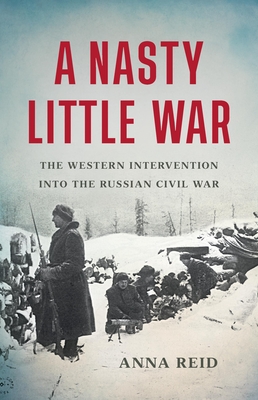
Anna Reid is the author of Borderland, a brilliant book about the history of Ukraine, and she tackles an even more complicated story in A Nasty Little War.
The Allies in WWI were under the delusional belief that they could intervene in Russia’s civil war, invade the country after the 1917 Bolshevik Revolution and Russia’s peace treaty with Germany, and force it back into the war and/or crush the Bolsheviks. Armies from more than a dozen countries landed in Russia’s Far East, in the Caucasus, and the frozen north near Finland. They fought a dizzying array of armies, supported over a dozen different governments, ignored the massacres of Jews as well as mass executions, and believed that they were making Russia great again. Or at least harmless.
Arrogance, lack of information and insight, shambolic planning, bigotry, and theft of supplies undermined the campaigns at almost every step. One of the most ludicrous examples of stupidity among many falls to President Wilson. He initially sent troops from Michigan and Wisconsin to Russia’s subarctic Murmansk and Archangel because it was believed they would be used to the cold.
If there wasn’t so much cruelty, confusion, death and and combat, you might think the months of political and military wheel spinning had been organized by Monty Python’s Flying Circus. Even when nearly 200,000 troops were on the ground across the vast country, they made very little impact. The only real success was establishing Red Cross hospitals which had never been a war aim and some treaty agreements for the newly-independent Latvia and Estonia.
The vivid and engrossing book is enlivened by quotations from letters and diaries and many of them from the Allied side are stunning in their crudity. Churchill as Minister of Munitions thought that Russia was “a very disagreeable country, inhabited by immense numbers of ignorant people.” As for the Bolsheviks, he likened them at various times to ferocious baboons, vampires, rats, crocodiles, and hyenas. He was hardly alone in his invective and myopia. My favorite English twit is the aristocrat who wondered airily in Vladivostok why anyone would want to live in Siberia.
Amid the fog of war, Jews suffered way out of proportion to their numbers: as many as 200,000 were victims of mass rape and murder. The culprits were Russians of all stripes, Poles, Ukrainians, Cossacks. Almost as disturbing as events that presage the Holocaust was the way that British politicians, diplomats and military officers downplayed, ignored, or denied that these horrific massacres were taking place. Readers might likely connect all of this to the October 7 Hamas attack on Israel.
The book teems with generals, warlords, politicians, Cossacks, coup leaders, assassins–and nationalities and ethnic groups–who most people have never heard of. Given the cast of thousands, A Nasty Little War could have used a Dramatis Personae section at the beginning to help readers keep track. It also lacks a detailed map of the Caucasus, but it’s otherwise stunning history of events that should be much better known. Because even an American president and a British prime minister didn’t know their countries had ever fought in Russia. ★★★★
Lev Raphael has reviewed books for The Washington Post, The Detroit Free Press, Jerusalem Report, The Ft. Worth Star-Telegram and several public radio stations in Michigan.