
Strangers on a Crazy Train: Book Review

★★★

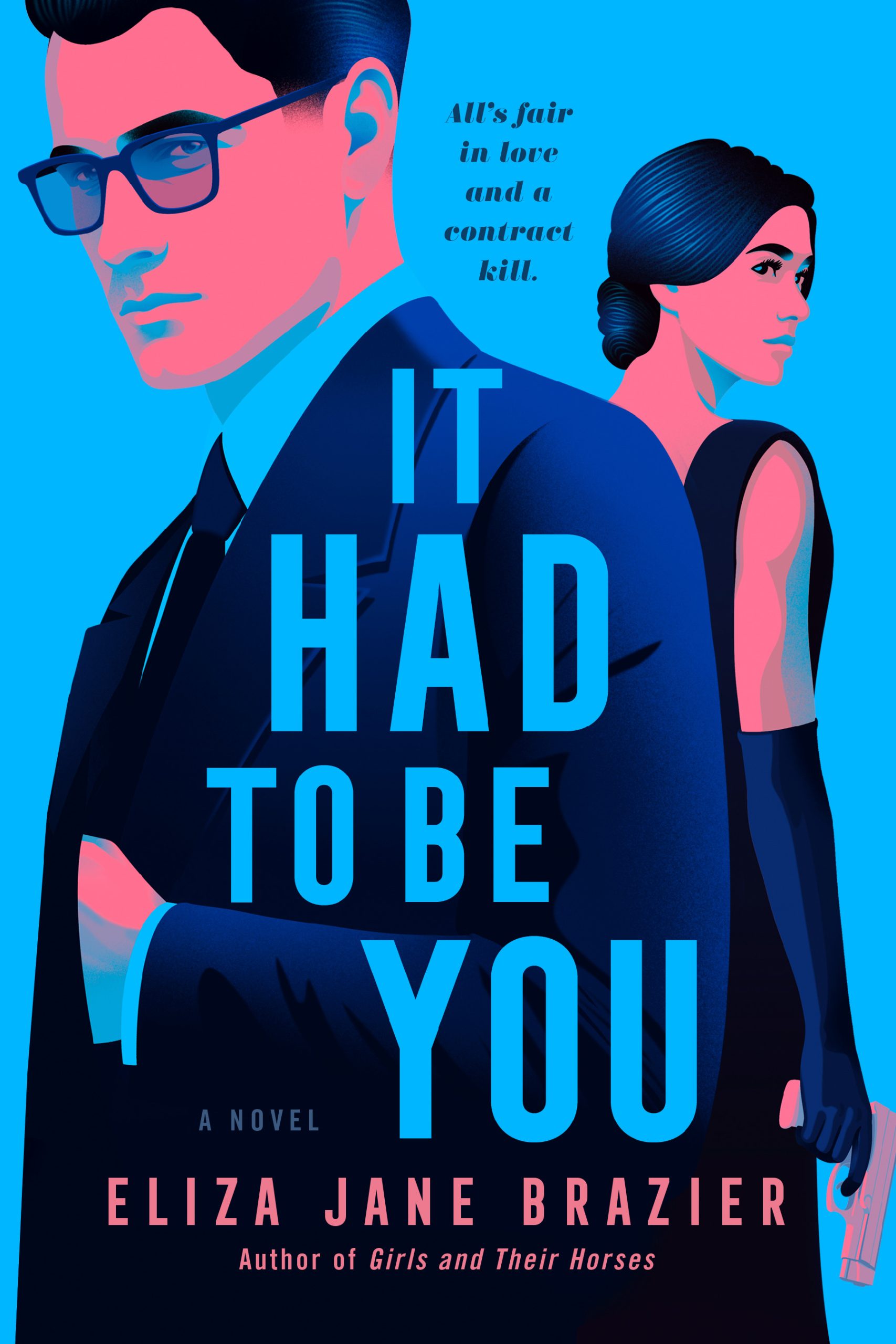
So there are these two contract killers who meet on a train to Paris.

That’s not the start of a joke. It’s the opening of It Had to Be You, an often bizarre novel labeled “romantic suspense” by the publisher. 

Jonathan and Eva are lonely and self-pitying sociopaths who feel most alive when they’re killing someone and earning huge fees from the respective agencies that send them out to commit murder. When they first meet on that Eurostar train, they end up having wildly intense and athletic sex on a luggage rack in the baggage compartment.

Sound improbable?  Well it’s even more so when you consider that drug-addled Jonathan has a bullet in his chest as well as what might be a concussion.  Also improbable: the fencing class where Jonathan’s neck gets cut by the teacher even though his face mask should have included protection for his neck. Likewise the scene where the two killers have a seven-course meal together at a tiny French restaurant whose owner’s name is Gestalt (!) and we only hear about the salad and the snails. Given that Jonathan’s a metrosexual sophisticate in Tom Ford suits, it’s weird that he doesn’t even discuss the wine.

After that first erotic onboard collision, he and Eva have been drawn back together because Eva feels that he ghosted her when in fact he just passed out in one of the train’s toilets. But he must be a horrible person for mistreating her, and because her job is killing horrible people, she becomes obsessed with revenge.  So she gets assigned to take him out. Jonathan, on the other hand, had plans for blockbuster sex on his mind, not murder. He’s been longing for one more magnificent encounter with Eva because he is “obsessed, magnetized, dangerously in lust.” 

Their paths cross again and again through the book with multiple plot twists amid the sex and violence. Both hired killers are surprisingly reflective about their lives, their outsider status, what it’s like to stalk and kill an assigned victim. This can sometimes makes for mordant comedy as when Eva thinks, “I know he’s lying to me, even though I’m lying to him, too….it’s how every relationships starts.”

But there are also lines that are laughable in and of themselves: “I want to touch her, but not so much, not all at once.  It is overwhelming.  I have been cooking her for so long that she burns.  I need to take her in slowly.  Blow on her first.” They’re almost redeemed by spots of lovely writing when the author describes Paris, something she excels at.

The publisher is targeting fans of Mr. and Mrs. Smith, Killing Eve, and perhaps folks who remember Prizzi’s Honor. It’s ultimately a very dark book that draws you deep into Eva and Jonathan’s sociopathy and trauma. Can they have a lasting relationship while the body count around them keeps mounting? The sketchy last pages seem to say yes because they feel like they’re setting up a sequel.

Lev Raphael is the former crime fiction reviewer for The Detroit Free Press and has also reviewed books for The Washington Post and several public radio stations in Michigan.

On Father’s Day I Remember My Father in the Kitchen

Father’s Day is about six months off from Hannukah, but it always makes me think of my father’s potato pancakes.

Made in a large, battered cast iron pan, these latkes were always perfect: crisp outside, juicy inside, delicious whether served with sour cream, sugar, apple sauce, or just plain.

I loved to watch my father cook, as patient as a scientist, as skilled as a musician playing a piece he’s performed more times than he can remember. Sometimes he even made what he called a potato babka: pouring the batter into a large loaf pan and baking it. The word itself still makes my mouth water decades later, though my own kitchen will never be filled with that aroma.

I’ve used all kinds of pans, potatoes and onions over the years, but have never been able to duplicate his latkes, not even with his advice. I’m not just being nostalgic and romanticizing the past. Back then, my mother said her latkes were never as good as his, and she had learned to cook in Belgium.

Did he consult a cookbook or was he remembering a recipe he had learned at home in eastern Czechoslovakia before the Holocaust? No, he just worked instinctively with the onions and potatoes, the flour, eggs, salt and pepper.

Years later, in a college course where we read Castiglione’s The Book of the Courtier, I learned a wonderful Italian word: sprezzatura. It was the art that concealed all art, the ability to do things flawlessly without betraying any effort. While my father was no Renaissance man — I don’t remember him ever cooking much of anything else — perhaps sprezzatura was a secret ingredient of those latkes.

And perhaps I tried too hard to match him, longed too deeply to recreate a moment in time that looked like magic and felt like a feast. These days, I don’t worry about equaling what he did, I just enjoy the memory of the love and dedication, the patience, and the sights and smells of my father loving his sons without words.

Lev Raphael is the author of 26 books in many genres which you can find on Amazon, most recently State University of Murder and Let’s Get Criminal, newly released as an ebook.

Remembering My Father’s Times In The Kitchen

Even though Father’s Day is about six months off from Hannukah, it always makes me think of my father’s rare times in the kitchen making potato pancakes.

Fried in a large, battered cast iron pan, these latkes were always perfect: crisp outside, juicy inside, delicious whether served with sour cream, sugar, apple sauce–or just plain. My brother and I tried them every way.

I loved to watch my father cook.  He was as patient as a scientist, as skilled as a musician playing a piece he’s performed more times than he can remember. Sometimes he even made what he called a potato babka: pouring the batter into a large loaf pan and baking it. The word itself still makes my mouth water decades later, though my own kitchen will never be filled with that aroma.

I’ve used all kinds of pans, potatoes, and onions over the years, but have never been able to duplicate his latkes, not even with his advice. I’m not just being nostalgic and romanticizing the past. Back then, my mother said her latkes were never as good as his, and she was a gifted cook.

Did he consult a cookbook or was he remembering a recipe he had learned at home in eastern Czechoslovakia before the Holocaust? No, he just worked instinctively with the onions and potatoes, the flour, eggs, salt and pepper.

Years later, in a college course where we read Castiglione’s The Book of the Courtier, I learned a wonderful Italian word: sprezzatura. It was the art that concealed all art, the ability to do things flawlessly without betraying any effort. While my father was no Renaissance man — I don’t remember him ever cooking much of anything else — perhaps sprezzatura was a secret ingredient of those latkes.

And perhaps I tried too hard to equal him, longed too deeply to recreate a moment in time that looked like magic and felt like a feast. These days, I don’t worry about equaling what he did, I just enjoy the memory of the love and dedication, the patience, and the sights and smells of my taciturn father loving his sons without words.

Lev Raphael is the prize-winning author of The Vampyre of Gotham and 24 other books in genres from memoir to mystery. You can study creative writing with him on line at writewithoutborders.com

Edith Wharton and Secret Love

Edith Wharton isn’t a writer you tend to think of on Valentine’s day. Her marriage was unhappy and the very secret affair she had in her forties was with a faithless cad.

No wonder that love in her novels is so often curdled, thwarted, or hopeless. Think of Ethan Frome, The Reef, The Custom of the Country, The Mother’s Recompense, The House of Mirth, The Age of Innocence.

But there’s so much to love and admire in her work: the wit, the dissection of social fossilization, the gimlet-eyed study of women’s objectification, the elegant knife-sharp prose, the passion under the surface.

Wharton’s The Age of Innocence ends with a quiet nod to a possible lost love of Henry James, as Cynthia Griffin Wolff wrote in her study A Feast of Words. Wharton knew a touching story that James had told to a mutual friend: when he was younger, James had once stood for hours somewhere in Europe, staring up at a balcony window, hoping to see a face. He hadn’t said whose face it was and Wharton recast the story in her own way at the end of The Age of Innocence. It was a loving private tribute to a man, now dead, who might have exasperated her sometimes but whom she had been devoted to.

Wharton exasperated me with her stereotypical Jew Simon Rosedale in The House of Mirth. How could such a gifted author betray her gifts like that?

When I re-wrote her novel as Rosedale in Love, I did my own version of her gesture to James by including a secret love and giving my book a surprise happy ending. Why not? I’ve been devoted to her fiction for years and it’s inspired me in my own writing to strive for the best.

Lev Raphael is the author of 25 books in genres from memoir to mystery. His other Wharton-inspired book is a mystery, The Edith Wharton Murders.