England’s Medieval Game of Thrones

While history buffs are likely very familiar with the Norman invasion of England in 1066, they might not know as much about the preceding half century and this epic book fills that gap.

It was a time of violence almost beyond belief, though it might remind readers of early 1900s pogroms in Russia and October 7th in Israel. Raiding Vikings from various countries as far away as what became Poland weren’t satisfied with just burning Anglo-Saxon towns and cities to ash–even if they’d received gold and silver as ransom. They raped women and cut off their breasts, threw victims into fires to burn alive, speared babies to death or smashed their skulls, and hanged men by their privates when they weren’t beaten, clubbed, or hacked to death.  The survivors often became slaves.

Strife seemed almost constant, with Anglo-Saxon and Viking armies “marching back and forth and up and down the length of England for years, each time inflicting punishment on whatever unlucky locals got in their way, for not having sufficiently resisted the previous conquerors.”  And as if that wasn’t bad, in Normandy, nobles were known to “tear each other to shreds and destroy themselves, for they lust after rebellion, love sedition, and indulge willingly in treachery.”

In both countries, alliances between factions and families could shift with stunning speed, oaths were followed by betrayals that were followed by promises of fealty, exiles and returns were as common as brothers having their own brothers murdered and treasuries raided. Feuds simmer and erupted and died down again, only to savage a new generation.

In these sometimes hellish landscapes, castles were besieged and destroyed and rebuilt, farms were burned, cattle slaughtered, and danger and death were omnipresent–and likewise disease, since the Anglo-Saxons had no understanding of hygiene. They used water riddled with garbage, human waste, and animal corpses. “Random death was so common in England that the Anglo-Saxons had a word for it, aelfscot, ‘elf shot,’ struck down by an invisible, otherworldly arrow.”

And among the various kings, lords, and chieftains on both sides of the English Channel (or “The Southern Sea”) there were plots, coups, murders, betrayals, assassinations and enough violence to make the series Vikings look like something from the Disney Channel.

Parallel to all this madness and dislocation was the quiet, steady, painstaking work of monks copying manuscripts in scriptoriums, work that was encouraged by Alfred the Great to save such treasures for posterity. That very human impulse to save learning and wisdom is both touching and fragile, because raiders had no use for books and loved burning them.

There’s what seems like a cast of thousands here and the names like Aelgifu are hard to scan, but the author does a decent job of individualizing people and separating legend from fact, as well a immersing you in a period that is at times both familiar and utterly alien. Hollway is especially good at charting the changing names of places from Latin to Danish to Old English and Modern English, helpfully explaining the roots of those names. All the same, the fusillade of names can sometimes be exhausting, especially when someone has two or more different names. And there’s way too much speculation about what people might have done or said or felt. 

Beyond that, this book that has two main faults, both of them inexplicable: there are no maps and no genealogies whatsoever, so it’s hard to picture where cities, counties, and countries are located when they’re mentioned, and hard to remember who’s related to whom–and how.  ★★★

Lev Raphael has reviewed books for The Washington Post, The Detroit Free Press and other news outlets as well as for several NPR radio stations, one of which hosted his interview show with guests like Salman Rushdie and Erica Jong.
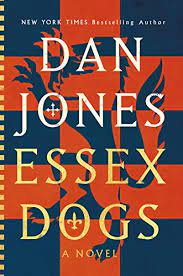
 

Essex Dogs is Disappointing Historical Fiction

I’ve enjoyed a number of Dan Jones’s popular histories like The Plantagenets and Magna Carta and have read a great deal about The Hundred Years’ War, so I was looking forward to his debut historical novel Essex Dogs.  It features a ragtag small company of soldiers and bowmen headed for Normandy in 1346 and ultimately the Battle of Crécy where the French lost to the English in a humiliating, historic defeat.  That battle changed the balance of power in Europe with France’s heavily-armored mounted knights beaten by the more mobile English troops and their archers.

It’s potentially superb material but the book feels cartoonish, partly because the dialogue is wildly anachronistic, stuffed with every version of the f-bomb you can imagine.  Historians agree that the word was not in popular use in the 14th century, but Jones’s characters sometimes sound like they’re in Goodfellas. “Fuck you looking at?” is one example, and for emphasis, that knight says it twice. The French are, of course, called “fuckers” and “fucking” is the invariable English adjective of choice, with “Fuck off!” a frequent command.  How did a responsible editor let this dialogue pass muster? 

At one point some variation of “fuck” crops up four times in only six very short paragraphs, and that’s not the only place where that word choice becomes an oppressive drumbeat.  Sometimes, though, the profanity becomes simply ridiculous, as when an earl shouts “The faster you fucking go, the sooner you’re fucking back!”


But profanity overkill isn’t the only problem with the prose.  There’s the leader of the small band, Loveday Talbot, remembering his “mantra,” knowing who “has his back” and there are people discussing how they should “play” a situation as they hit the beach in Normandy.   This discordant dialogue had me on the alert for someone saying “Let’s do this thing.”  It didn’t happen, but there was this priceless piece of defiance going into battle: “Let’s show them who we are.”

It’s a shame that the writing isn’t better because Jones does a decent job of making you feel the heat and filth of the expedition of 15,000 men, along with the chaos  of their landing and the brutality of combat. But sometimes it feels as if he’s reveling in the gore and grime.  That gets tedious, and there’s way more phlegm, spit, shit, and snot than the book needed.

One other aspect weighs the novel down: there’s a grotesque, drunken, slovenly, drug-addled, farting priest whose presence in the company is totally unnecessary.  He adds nothing to the story and it’s a relief when he’s dead, though that takes over 250 pages to happen.  It’s hard to care for him or any of the other characters in this book since they’re all one-dimensional and that even applies to Loveday himself.

Though Jews were expelled from England in 1290, Jones has a Jew as a former member of the company some fifty years later–and gives him an improbable name: Wiseman the Jew. Plenty of sources show that Biblical names like Jacob, Moses, Samuel, Isaac, Joseph and Abraham would have been much more authentic for an English Jew if he had somehow managed to be living in England at that time and serving in the army of Edward III.  Even the Latin Benedict (for Baruch) would have made more sense since Jews sometimes used Latin names derived from the Hebrew.  More puzzling than that, Edward III’s son, later the famous Black Prince, is portrayed as a whining, drug-addled, annoying teenage brat and there’s nothing remotely epic about the climactic Battle of Crécy that everything has been leading to.

The book is a very long slog compared to the richly-imagined and beautifully-written historical novels of  Bernard Cornwell set during the Hundred Years’ War.  Read any one of them, like The Archer’s Tale, for a truly immersive experience.  Cornwell doesn’t kick you out of his fiction with glaring anachronisms or gratuitous profanity, and his deep characterization, his sense of texture, and his grasp of human and period psychology are far superior to anything you’ll find in Essex Dogs.  Jones says in his acknowledgments that he was encouraged to write fiction and I wish he’d gotten better advice on how to work in a new genre.  ★★

Lev Raphael has reviewed books for The Detroit Free Press, the Washington Post, Jerusalem Report, Bibliobuffet, The Ft. Worth-Star Telegram and various public radio stations.