Review: Revenge is Best Served Boiling Hot

★★★★

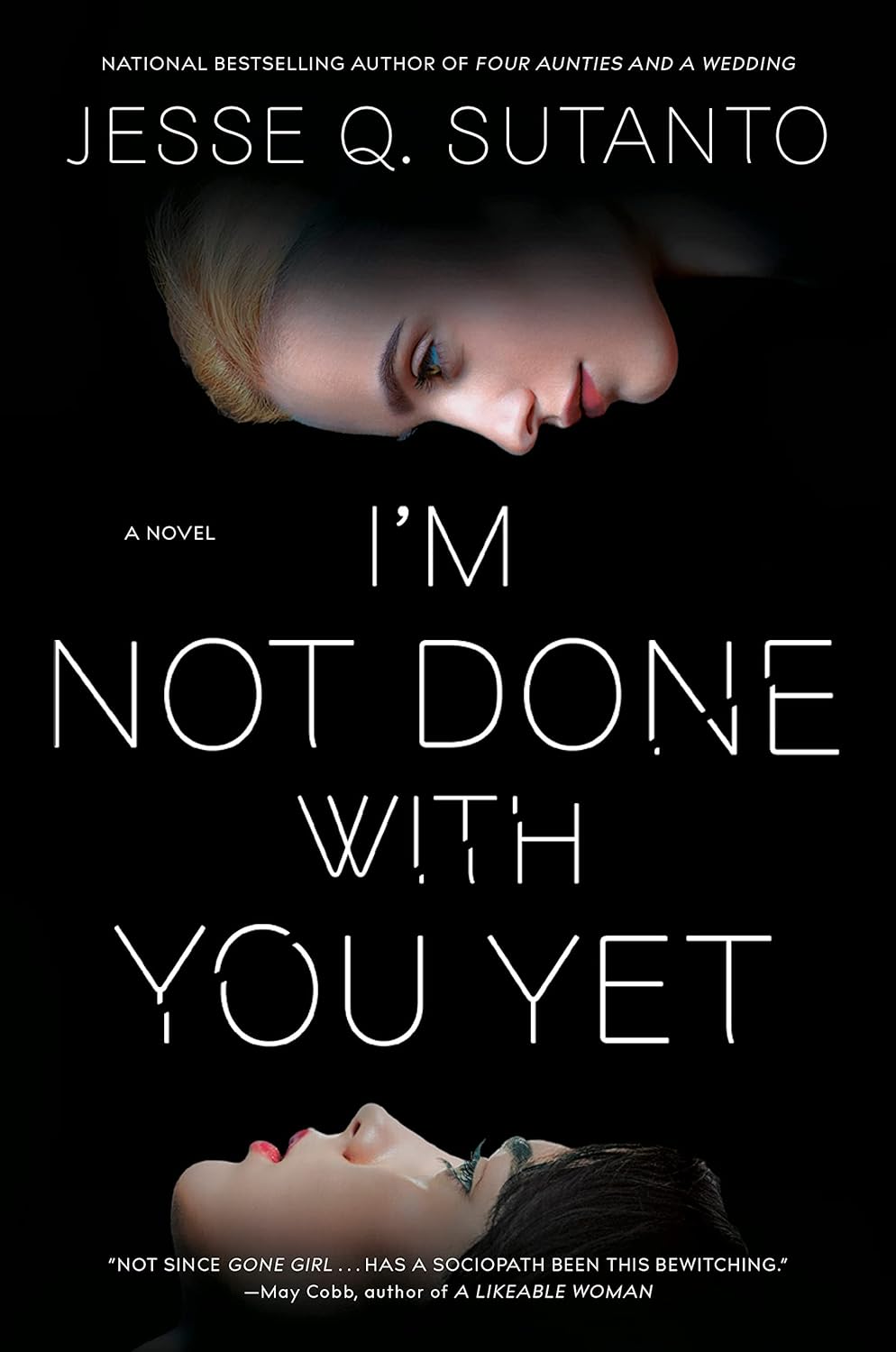
Meet wildly paranoid and sociopathic Jane Morgan. She’s a midlist author with a dismal career; an obnoxiously superior, unsupportive husband; and a deep wellspring of jealousy and rage.  Being half-Asian has always been a source of shame for her because her family is poor and she’s not slim, glamorous, and beautiful.  She thinks she deserves to be one of those Crazy Rich Asians.

She hates herself as “wildly mediocre,” hates that husband, her career, social media influencers, successful writers, and especially hates California where she grew up because it’s the worst place in the world for someone antisocial like her:

“It’s too loud, too sunny, too fucking friendly. Everyone gets revved up on kale smoothies and cocaine so I can’t even get a tub of hummus without the Trader Joe’s checkout lady grinning at me and calling me honey and asking me how I’m doing and what are my plans for the weekend?  Californians just can’t help themselves.  If I stayed there any longer I was bound to kill someone.”

Jane’s rancid, roiling sarcasm doesn’t simply cut with a razor throughout the book, it wields an axe–and that’s perversely entertaining in this dynamic thriller.

When Jane did her creative writing masters at Oxford University, she became obsessed with Thalia, a gorgeous, charismatic, and wealthy woman in the same program. Thalia seemed to like her, which astounded Jane. Their lives mesh in reality and fantasy as the book goes back in forth in time, taking readers deeper into Jane’s pathologies. 

Sutanto has a superb ear.  She’s given Jane a dazzling, dark, compelling, sometimes appalling/sometimes hilarious voice of a woman trapped inside her own head who hesitates at the simplest reply because she has to make sure that it sounds “normal.” After all, she thinks that her “thoughts are spiders waiting to leap from my tongue and poison everything they touch.”  And they’re worse than that since she often thinks of stabbing people just to shut them up.

She can also imagine walking through a museum “with a little razor, casually slicing apart priceless canvases” because “there’s just something about perfection that makes [her] want to defile it.”  Plain Jane is a ferocious savage inside.  Does Thalia tame her?

Some readers might find the multiple plot twists in the final chapters excessive.  All the same, Jane and Thalia’s story is a cunning exploration of hero worship, shame, internalized racism, and the splendors and miseries of female friendship. On top of everything else, it’s a sharp and knowing satire of publishing: “Anyone who thinks that publishing is a meritocracy is not in publishing.”

Lev Raphael is the former crime fiction reviewer for The Detroit Free Press and has reviewed for The Washington Post as well as several Michigan radio stations, one of which aired his interview show. His guests there included Doris Kearns Goodwin, Salman Rushdie, Julian Barnes, and Erica Jong.


“Transcription” Is The Dullest WW II Novel I’ve Read In Years

When I started reviewing crime fiction and other genres for the Detroit Free Press back in the 90s, I made an odd discovery.  Reviewers, friends, acquaintances would be raving about a book or an author.  I’d get a review copy and think, “Huh?  What am I missing?”  I remember one book that was hailed across the country in almost ridiculous terms, with one major reviewer gushing that it wasn’t just a book, it was an experience.

Well, isn’t reading every book an experience of some kind?

The second part of this discovery was that when I’d be out on tour for one of my own books, when it came time for Q&A, eventually someone would ask about one of these books the whole world seemed to worship and adore.  The questions always came a bit tentatively, as if it was heretical to even raise them.  I would be honest but focus on something technical.  For instance, with one wild best seller, I said I just didn’t believe the voice was the voice of a teenager.

I’ve been observing the love fest for Kate Atkinson for awhile. Friends have urged me to read Life After Life or Case Histories, and I just couldn’t get into them.  Then a best friend sent me three of her books as holiday gifts.  I picked Transcription because it was the shortest, and I was determined to finish it so we could discuss it.  This is the story of a young woman, Juliet Armstrong, drawn into the fringes of England intelligence in 1940. Her job is typing up transcriptions of bugged conversations of British Nazi sympathizers.  If it sounds dull, it is.

Nothing dramatic happens until halfway, and even then, the drama is relative. Eventually something more exciting does take place, but as WW II books go, this is a sleeper.  I have nothing against war novels that are literary fiction: One of my favorites is Helen Humphreys’ Coventry, which is poetic and intensely dramatic.  But Transcription was annoying in a number of ways.  Apparently shifting decades is one of Atkinson’s “things.”  I found it frustrating.  A straightforward narrative would have ramped up the tension.

But the narrative itself was more awkward and off-putting than the structure.  Juliet is given to incessant thinking about her thinking and to making silly puns.  When told to keep an ear out, she notes that she has two.  Hah.  Hah.  The trivial focus on her mental commentary is relentless and her observations are sometimes ridiculously banal: “But then, what constituted real?  Wasn’t everything, even this life itself, just a game of deception?”

There’s a plot twist at the end that doesn’t quite relieve the boredom of the previous 250+ pages. There’s also so much tea drinking that after awhile you begin to wonder if the book is meant to be some kind of spoof of British fiction.

After finishing, I found that a host of highly disappointed readers on Amazon found similar problems with the book.  Me, I read it out of loyalty to my friend, and finally out of morbid curiosity: could it really go on like this page after page?  It did.

With twenty years of university teaching behind him, Lev Raphael offers a range of creative writing workshops online at writewithoutborders.com.  “Studying creative writing with Lev Raphael is like seeing ‘Blade Runner’ for the first time: simply incredible.”—Kyle Roberts, Michigan

How to Write a “Big Book”

Lots of writers dream of writing a “big book.”

It’s a book that gets advertised and reviewed everywhere.

A book that people are reading on trains, planes, subway, and listening to in their cars on cross country trips or morning commutes.

A book that everyone sees at airport book racks. A book that makes all the best seller lists and prompts speculation about who’s going to star in the movie.

A book that becomes part of the cultural conversation, even briefly. A book that gets the author onto countess chat and interview shows across the country.

A book that seems to be everywhere you look and that all your friends are talking about.  A book that book groups can’t wait to dive into.

What special talent does it take? What magic do you need?

Well, it’s crucial that the book is physically big.

500-600 pages is big book big. It tells readers that they’re buying something the publisher has invested lots of time and money in. Think The Historian, Mystic River, The Secret History, The Girl With the Dragon Tattoo.

I know of a writer who was doing well with a series and was told very frankly by an editor that to break out, to have a big book, that writer had to write books that were much longer. This is a true story. And kind of sad, because I thought that writer’s series was terrific.

Then I read the author’s breakout book which, you guessed it, became a big book with a star-studded movie and all the trimmings.

It felt overwritten and padded, easily 100 pages too long, if not more.

But the strategy worked. This author is now wealthy and famous, though not a better writer.  Just a bigger one.

Does size matter? Yes, if you want to make it big in traditional publishing.

Lev Raphael is the author of 25 books in many genres, including The Edith Wharton Murders, his first book to be reviewed in The New York Times.  It’s well under 500 pages.  🙂