Should Writers Follow Elmore Leonard’s “Rules”?

Every now and the I see people post and re-post Leonard’s well-known rules for writers. Some of them are common sense, like “Never use a verb other than ‘said’ to carry dialogue.”  Taken together, though, they seem to suggest that you should write in a very lean way.  Like Leonard himself.

elmore_leonardOne of the rules is “Avoid detailed descriptions of characters.”  He references Steinbeck and Hemingway, but does Leonard follow his own advice? Below are some passages about the thug Richard Nobles in the novel LaBrava  (aren’t those great character names?)

He was thick all over, heavily muscled, going at least six-three, two-thirty.  Blond hair with a greenish tint in the floodlight: the hair uncombed, clots of it lying straight back on his head without a part, like he’d been swimming earlier and had raked it back with his fingers.  The guy wasn’t young up close.  Mid-thirties.  But he was the kind of guy–LaBrava knew by sight, smell and instinct–who hung around bars and arm-wrestled.  Homegrown jock–pumped his muscles and tested his strength when he wasn’t picking his teeth.

An ugly drunk.  Look at the eyes.  Ugly–used to people backing down, buying him another drink to shut him up.  Look at the shoulders stretching satin, the arms on him–Jesus–hands that looked like they could pound fence posts. 

Nobles, with his size, his golden hair, his desire to break and injure, his air of muscular confidence, was fascinating to watch.  A swamp creature on the loose.

labravaI see plenty of rich, evocative detail there, and it’s all well-chosen.  We get bits and pieces of the physical that create Nobles as an individual who’s anything but noble.  We also see him as a type known to LaBrava who’s assessing him, and the images are powerful (swamp creature, pounding fence posts).  Better yet, we have an evocative portrait of Nobles’s impact on people, the violent aura created by his mood and by his muscles.

Lean?  Not really.

It’s easy to quote Leonard, but it’s far more interesting to read him and see how closely he sticks to his own rules.  One question is, does it matter?  Another, the more important one is this: why should what works for Leonard–or what he implied worked for him–work for you?

I think in the end you can learn a lot more about writing from reading Leonard’s books than reading and slavishly following his Rules.  It’s also more fun.

Lev Raphael is the author of 25 books including Writer’s Block is Bunk.

Reading “To Kill a Mockingbird” As an Adult

When the first Hobbit movie was coming out, I re-read the novel I loved as a kid to reacquaint myself with the story and was more enthralled than I expected to be.

The wry voice was something I missed as a twelve-year-old in love with the adventure and fantasy, and I reconnected immediately with what moved me most the first time: the ways Bilbo’s fooled Gollum and the dragon. In each case, the small, clever Hobbit outwits a fierce enemy.  That was a real treat for me as a bookish, picked-on kid with a tough older brother.


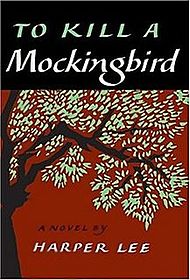
Harper Lee’s Scout also defeated monsters when she helped defuse the mob in front of the jail. It’s one of the best scenes in To Kill A Mockingbird–if not entirely believable.  But Scout herself doesn’t hold up for me today because I just don’t believe her voice. She often sounds too mature for an eight-year-old, like when she thought near the end of the book (according to her adult self) “there wasn’t much else for us to learn, except possibly algebra.”

190px-MockingbirdfirstAnd I’m mixed about the book itself: it feels like an uneven blend of southern novel of manners with the “race novel” Lee originally intended, folded into a  courtroom drama which seems clichéd–through no fault of hers. We’ve all read so much John Grisham and Scott Turow, or maybe I have as a long-time crime fiction reviewer.  The story of the rape accusation takes way too long to get going.  And in terms of suspense, the final appearance of Boo Radley is a letdown after all the mystery and tension.  He’s just not that interesting.

Some of Atticus’s sentiments also grated on my nerves, like his belief that “a gang of wild animals can be stopped, simply because they’re still human.” That feels hopelessly naive and sentimental–especially when you consider that Lee wrote the book after The Holocaust.  But closer to home, there was the brutality she saw in the south directed at Civil Rights protestors.

Flannery O’Connor damned the novel with pretty faint praise when it came out: “I think for a child’s book it does all right.” That seems unduly harsh (and unfair to YA literature). What works best for me as an adult reader is the local color, the barbed social comedy, and the graceful prose.

Of course the book’s dramatic core couldn’t be timelier: today’s America is still grappling with racial injustice just as Harper Lee’s fictional town was in Depression-era Alabama.  That’s sadly a story which seems to make the news every week–if not more often.

Lev Raphael’s 25 book Assault With a Deadly Lie is a suspense novel about militarized police.  It was a finalist for a Midwest Book Award.

“Am I In Your Book?”

I once heard a rumor that someone thought they were “in” one of my mystery novels and was really pissed off.  Well, it was a bizarre situation because this person wasn’t remotely in my book, not even near my book.

On the other hand, a fan once jokingly said, “You should put me in one of your mysteries” and I walked away smiling.  Because this fan–a lifetime academic–had apparently read them all without realizing I’d used a dramatic incident from the fan’s life as a plot point in one of the books.  So you could say that fan made a phantom guest appearance.  Sort of.  Or a contribution?

The thing is, nobody gets shoved into my books from real life.  Ever.  And each one of my characters is a composite of fact and fiction.  Sometimes more of one, sometimes more of another.

Take Juno Dromgoole in my Nick Hoffman mystery series.  She’s a luscious professor of Canadian Studies who’s beautiful, foul-mouthed, and intemperate.  By making her over-the-top, I was playing with the American image of Canadians as quiet and well-mannered.  How was she born? She was actually inspired by several different women I met at a mystery conference.  But the more I worked on her, the more she became sculpted by the storyline and interactions with other characters and the further away she grew from her “sources.”  I don’t even remember anymore who those women were exactly, but I did finally imagine her as having the glamor of Tina Turner at her best.

Curiously, I did once run into a woman who looked and dressed just as I envisioned Juno did, when I was staying in a German hotel on a book tour–and she was Italian.

The smallest thing can inspire me: a look, a gesture, an outfit, a snarky line, an accent–and suddenly a grain of sand is on its way to becoming a pearl.  So people do make their way into my fiction, but always through shards, fragments, bits and pieces.

Even if I had wanted to put that angry person mentioned above in my book, I wouldn’t really have been able to.  For me, people are just models and sometimes inspiration.  Fiction sculpts them into something completely different from what they were until they become unrecognizable. If it’s good, of course.

Lev Raphael is the author of The Edith Wharton Murders and 24 others books in many genres which you can find on Amazon.

When Motives Miss by a Mile

I started reading crime fiction in high school: Agatha Christie, the Swedish writing team Maj Sjöwall and Per Wahlöö, John Creasey, and the comic work of Phoebe Atwood Taylor.  I wasn’t great at solving puzzles, but I was always fascinated by what would actually drive someone to murder.

phoebe atwood taylor

That fascination took a different turn when I started reviewing crime fiction for The Detroit Free Press in the 1990s and continued to do so for about a decade.  Motive now wasn’t just something to study, it had to to be convincing, it had to fit perfectly into the entire clever construction of plot–or the carefully-built edifice buckled and sometimes even collapsed.  Reading crime novels where the motive for murder or mayhem was weak made me determined to ensure that my own mysteries never fell short that way.

And because I watch a lot of crime drama on TV and crime movies, I’m often thrown when a motive just doesn’t seem believable.  Case in point.  In a recent episode of Forever, whose sleuth is a medical examiner, a ballerina’s foot was found at a theater.  She was initially presumed dead until it was forensically determined that the foot had been surgically removed so as not to kill her.  Weird, right?  The suspects narrowed down quickly to her ex-surgeon brother and all the evidence was discovered in his home.

But why?  Jealousy?  That didn’t add up.  They’d escaped Cuba together so she could have a great career and she on the point of stardom, about to be dubbed a prima ballerina (the show actually got this wrong, mistaking a prima ballerina assoluta for a prima ballerina)

There’s a good chance in crime fiction that the “least likely” suspect is the one who did it, and when she was was found alive, I couldn’t imagine why she would have had her brother do it.  But she did, and here’s the bogus motive the writers came up with: 1) she had a degenerative bone disease and 2) she had only a year to dance and so 3) she wanted to go out in glory and be remembered forever that way.

I’ve known dancers and I thought this was ludicrous.  What dancer would consent to having her foot cut off even if she wouldn’t be able to dance again?  What person would consent to such horrible mutilation and be left crippled for the rest of her life?  Nothing about the character made her seem unhinged enough to do something so radical.

Sometimes crime writers of all kinds try so hard to be original or surprising that they end up just coming off as ridiculous.  This was one of those times.  She was still able to dance and she could have danced with the title and then retired for whatever reason and remained legendary.  Now she’s a legend in a freakish way (and is missing a foot!).  Why would any dancer want to be remembered like that?

Lev Raphael’s 25th book is the Michigan bestseller Assault With a Deadly Lie.  You can read about his other mysteries at his web site.