Mystery and Mockery

My European-born mother was given to making pronouncements about life in the U.S. that were halfway between a judgment and an epigram. One of my favorites: “There is no such thing as enough in America.”

I thought of that while reading  the entertaining Yellowface, in which a struggling author, June Hayward, steals a manuscript from her famous, best-selling Chinese-American friend after she dies.  June fills in gaps, polishes it extensively, and gets it published as her original work.  She becomes a huge success, but every thing she gains makes her hungry for more.

It’s initially great fun to watch her first rave about the stolen manuscript, then slowly find fault with it, then fix the problems she sees and tone down the excesses, and finally claim that’s it’s undeniably hers because it’s so much better.  And isn’t she doing her friend a great service in making it a better book?

Selling the novel turns her world upside down and June is overwhelmed by her good fortune: a vast amount of money, a publishing house that really cares about her, headlines everywhere she turns, best-seller status, great reviews, profiles in prestigious magazines and newspapers, strangers recognizing her.  She becomes a celebrity author, though she knows that it could just as easily have been someone else who was picked to be turned into a star. 

The downside is her incredibly masochistic addiction to reading everything she can about herself in print and on social media, which can either be a serotonin boost (as she’s overly fond of saying) or infuriating when she’s accused of cultural appropriation because she’s white and the book is primarily about Chinese laborers in France during WWI.

Kuang certainly knows how to mock the publishing world as well as Robert Harris does in The Ghost Writer, and she takes special aim at complaints of cultural appropriation that will remind you of the controversy over American Dirt.  She also eviscerates what Joni Mitchell called “the star-making machinery” that elevates certain writers for other reasons than the quality of their books.

Yellowface can be read as a sort of mystery-thriller because as soon as June steals the manuscript and decides to publish it, you feel a clock ticking: won’t someone discover her fraud and shame her–or worse?  Of course, it doesn’t take long for the predictable Twitter mobs to attack her, and the waves of Twitter warfare in this book are exhausting.

You may be wondering if the book ever explains why June steals Athena’s work, and the real answer goes beyond jealousy in a devastating set of revelations. 

Given that Kuang is the kind of megastar author who dies in this book, is her satire of the struggling friend empathetic or cruel?  That’s one question.  Another is the revised, stolen novel itself.  When June shares some sections of the book that she actually wrote (bragging about their brilliance), the writing doesn’t seem stellar, yet she claims the audience is under her spell.  Why didn’t Kuang’s editor pay special attention to those passages to make them more convincing? 

As reported in The Washington Post, this novel “is now at the center of a real-life publicity frenzy, its cover gracing tote bags, railway ads and a giant mural at the London Book Fair.”  That’s the kind of PR that June gets in the novel for her book.

Yellowface interrogates friendship, jealousy, the randomness of fame, and the truly bizarre realities of publishing today.  The last half really gathers steam and elevates the book above satire.  After you finish, you might well decide to cut Twitter loose and give up doom-scrolling forever.  If you can. . .  ★★★★

Lev Raphael has reviewed books for The Detroit Press and many other publications.
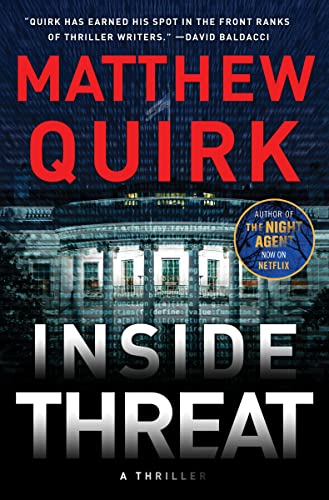
 

Presidential Thriller: “Inside Threat”


Is President Kline in Matthew Quirk’s new conspiracy thriller the target of an insidious plot by government insiders to overthrow him, or is he himself planning some sort of coup that will make him a virtual dictator? Can Eric Hill, a CIA agent demoted to desk duty save the country and the president? 

These questions drive Inside Threat, a book which will likely remind you of movies like Olympus Has Fallen, White House Down, and In the Line of Fire. Quirk’s debut thriller Night Agent was a recent Netflix hit and this book feels like it’s been written to be turned into another limited TV series. The book is light on description except when it comes to the fascinating mountain fortress the president is hustled off to when the White House is seemingly breached. 

Based on a real government site, the massive retreat is meant to be impregnable, with gigantic blast doors securing it from every possible threat, man-made caverns, buildings inside those caverns that rest on grids of gigantic springs, a reservoir and power station, multiple tunnels and a sophisticated ventilation system. According to a White House website, “In addition to the basic life support requirements of power, water, and air, the underground metropolis also contains a medical and dental clinic, fire department, post office, dining facility, snack bar, dormitories, chapel, barbershop, fitness center, bowling alley, and even a Starbucks.”

In an author’s note, Quirk notes that he’s simplified the layout, hoping that the maze-like interior doesn’t make it hard for readers to find their bearings.  You will probably still need to consult the map of this redoubt.

Quirk has a firm grasp on the “can-the-good-guy-be-redeemed” thriller motif, but the book isn’t seamless.  I think a better editor would have cut the genre cliché of the villain speaking in a “chilling whisper.”  And careful copy editing would have flagged repetition of  details about the retreat, the “forest” of springs under each building, and lines like “She seemed to be restraining an agitated energy,” “A leaden sickness grew in the president’s belly,” and “A nauseous feeling took hold of Eric.”

More importantly, the many intense action sequences could have been made clearer, especially since the complex is filled with entrances,  exits, and secret passages.  Though he does keep you guessing about the president’s real intentions, the reasons for the conspiracy also aren’t entirely convincing and Quirk hasn’t made the president’s policies and record clear enough.

All the same, Inside Threat is a classic, high-energy thriller as one explosive crisis  follows another.  And the next time you see Secret Service agents protecting anyone in real life, they could bring to mind Quick’s hero describing the sad realities of the job: “You go behind the curtain.  You see the mismatch between the public and private faces.  You keep your mouth shut.  It’s not always pretty.” ★★★★

Lev Raphael has reviewed mysteries and thrillers for The Detroit Free Press and other publications.

“The Game She Plays Can Turn Deadly”

Siena Sterling has combined some time-tested fiction tropes in her new quasi-suspense novel: the fish-out-of-water, posh country house gatherings with some kind of accident, the femme fatale, and a woman worried she’s not good enough for her lover. The results are uneven despite the surprise at the end.

It’s 1980 and after a bad breakup, Nicola leaves benighted Buffalo for Paris but is  easily swayed on board her flight by a charming Englishman, James, to spend time with him in the south of France.  She’s so naive and unworldly that she wonders if there’s a bakery in his village because one of her goals in life is to eat a flaky croissant.  Sterling misses a chance to offer readers something special when Nicola and her boyfriend visit the southern French town of Uzès and there’s no description of its cathedral, the duke’s castle, or the lovely arcades. 

The pair go off to a country manor in England to spend a shooting weekend with James’s friends where Nicola is astonished and humbled nonstop. His friends all went to Cambridge together!  How does she know which fork to use at dinner!  Brits can be snide!  Why hasn’t she seen the cook!  Three-course meals are exotic! The hosts will someday have titles of nobility! They already have servants!

But for all her cluelessness, Nicola can somehow imagine the most attractive woman in the group would be more fitting in a “salon entertaining French philosophers and Russian novelists.”  That seems too sophisticated an observation for Nicola the way she’s been written.

As for the femme fatale, she’s repeatedly called beautiful and stylish, but she comes across as a run-of-the-mill narcissist, so whatever schemes she has in mind (remember the title) are painfully obvious.

Jealous of this woman’s acrobatic skill during a stupid parlor game after dinner, Nicola actually jumps onto a glass table and humiliates herself despite being uninjured amid all the broken glass.  That reaction makes sense, but she’s so shame-bound and clueless through the book that it feels like overkill–and even worse, she’s not the only hapless female in the book.

The English shooting weekend is marred by someone getting shot (of course), and there’s also a mysterious rich German present who’s so quickly whisked off-stage you wonder why the author bothered.  A second shooting weekend up in Scotland is more dramatic, but it takes way too long to arrive and there’s a clichéd taunting speech by the book’s villain.

The book’s title is a partial misdirection and that’s where the surprise comes in which is arguably the book’s best moment.  Unfortunately, the prose is bland, the settings aren’t vivid enough, and the characters lack depth.  For an unforgettable English house party novel, try Ruth Ware’s In a Dark, Dark Wood or Isabel Colegate’s classic The Shooting Party.  Both are tremendous reads.  ★★

Lev Raphael was the longtime crime fiction reviewer for the Detroit Free Press and has also reviewed for the Washington Post, Jerusalem Report, and several public radio stations.  Guests on his interview show included Erica Jong and Salman Rushdie.

Life and Death in Berlin

It’s been said that Berlin is a city with “too much history” and reading this fascinating, encyclopedic book you can see why. Relying heavily on the letters, diaries, and accounts of ordinary people like clerks, housewives, factory workers, and teenagers, the author charts the complex transition of Germany’s capitol from the end of WWI to the end of WWII and beyond, from rebirth to almost total destruction to rebirth, division and union. 

In the first part of the book we follow Berlin’s path from imperial capital to hotbed of anarchy to democracy to the rise of fascism.  It all seems to happen with dizzying speed in a city internationally renowned in the Teens and Twenties for its striking architecture, its art and music, its amazingly open gay culture, and a boom and bust economy that ruined the lives of far too many citizens. 

Life seemed even faster-paced than in New York City and change could happen with frightening rapidity; equally frightening was the violence that broke out between varying political factions well before the Nazis took complete control and the insane mob violence directed at Jews.

The author deftly captures the bureaucratic madness of Nazi rule as when he lists some of the attempts to control the jazz that citizens enjoyed.  Rules stipulated, for instance, that jazz played on the radio should not have “rhythmic reverses characteristic the barbarian races and conducive to dark instincts alien to the German people.”  As opposed to the dark instincts that they were at home with?

In the second part, we enter the downfall of Berlin at the end of the war, experiencing life under ceaseless bombardment by Allied bombers and then Soviet attacks as they seek to pulverize the city and extirpate fascism.  It’s suitably grim as citizens live without electricity, heat and adequate water inside subway stations and basements, scrounging for food, desperate not to be killed while out in the open or buried alive.  Anyone reading news about the current war in Ukraine will recognize the horrendous living conditions under siege, though the aggressor is different.

Surprisingly, the shortest section of the book might be the freshest for people who’ve read books like Berlin at War by Roger Moorehouse or Germany 1945 by Richard Bessel.  Here McKay explores the chaos in a city not fully divided between the Western Allies and the Soviet Union, the growing iron fist of Soviet rule, the ways in which people coped or escaped, the re-emergence of cultural life across the city and the widely-held alarm in East and West Berlin about rock music and how it supposedly endangered teens.

Given how often jazz comes up, it’s strange that there’s no entry for it in the index, and though the author occasionally mentions Berlin’s famous cynical humor, he doesn’t offer enough of it to match his characterization of Berliners as ultimately resistant to authority.  Readers interested in that side of the story would probably enjoy Rudolph Herzog’s Dead Funny: Humor in Hitler’s Germany.

These minor flaws aside, the book is an evocative tribute to a city whose energy is admired worldwide.   ★★★★

Lev Raphael is the author of the memoir/travelogue My Germany and 26 other books in many genres.


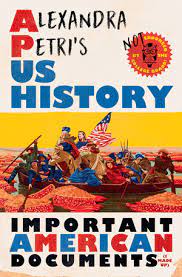
Alexandra Petri Rewrites American History (and more!)

Bummed out by politics, climate change, inflation, long Covid? Alexandra Petri, Washington Post humorist, has the answer as she charges into the controversy over what students should know about American history and literature.

She’s made stuff up. Hilarious stuff, like John Adams and his wife doing the 18th century version of sexting, which doesn’t go very well. And the story of one of the famous colonial Minuteman who were supposedly able to defend freedom in a minute.  This guy wasn’t exactly on time, taking a few hours to get ready because he couldn’t find his musket or his boots and he wanted to prepare some snacks for the battlefield.  His wife had a few things to say about that.

Petri toys with documents like The Federalist Papers and The Gettysburg Address, but some of the funniest entries in this collection are new takes on American literary classics  like Moby-Dick, Leaves of Grass, The Great Gatsby, Howl, In Cold Blood, To Kill a Mockingbird, and The House of Mirth.  Edith Wharton character dolls?  Why not!  And why shouldn’t the man who bought The Yellow Wallpaper‘s wallpaper request a refund?

English majors, rejoice: Who else in the world would be doing a spoof of James Baldwin’s Giovanni’s Room (one of my favorite novels)?  And the Raymond Chandler satire made me laugh all the way through–it’s one of the funniest pieces in the book, and maybe in human history.  At times the dry turns of phrase reminded me of Philomena Cunk.

Petri’s pastiche of iconic figures is always piercing and revelatory, as when Frank Lloyd Wright tussles with a client about the commission to build the perfect home.  Guess what?  It’s not remotely what the client wants.  And her take on The Teapot Dome Scandal eerily prefigures excuses we’ve recently hear that “explain” why certain figures in government have seen so much money changing hands.  I name no names.

Petri is fiendishly well-read and her humor is consistently delicious, like the lost vignettes from Fifty Shades of Gray that pop up throughout the book which range in time from the Puritans to Trump (sic transit insania mundi).  You’ll never think of Patrick Henry the same way again after Petri serves him up to you with special sauce–and who else could have imagined customer reviews of Our American Cousin from the night Abraham Lincoln was shot?

Writers can learn a lot from her satire and may especially appreciate troubled fan mail to Harper Lee wondering about that missing mockingbird as well as the monomaniacal letter Loraine Hansbery gets about promoting raisins.

The title of the book clearly indicates that Petri made all these documents up, but you have to wonder if this book will get devoured by AI chat bots anyway.  I can imagine students turning in essays about how Melville’s publisher wasn’t very keen on the idea of a book (mostly) about whales.  And much, much, worse.

Well, given the state of academia today, with enrollments going over a cliff, professors can likely use a good laugh.   ★★★★★ 

Lev Raphael is the author of the satirical Nick Hoffman mystery series along with seventeen other books in many genres.  He has reviewed books for The Detroit Free Press, Jerusalem Report, The Washington Post, The Ft. Worth Star-Telegram, Boston Review and a handful of public radio stations in Michigan.

Tudor Thrills & Chills


Vanessa Wilkie’s book focuses on a powerful woman and her dynasty, a woman who should be much better known.  This is a compelling story of upward mobility as Alice Spencer, the daughter of a wealthy sheep farmer, rose to wealth and status through two important marriages, married her daughters off extremely well, and worked hard to maintain all the right connections.

Status anxiety was rampant in this period and the author clearly lays out the importance of finding the right patron and keeping him happy, of marrying well, of expanding one’s holdings of land, and doing everything possible to rise higher.  There was always the possibility of the Wheel of Fortune dropping you to the bottom in an instant.  Doom could be quick and sudden and your head could end up on a pole.

There are times when the book reads like a thriller, as when Alice’s husband, the Earl of Derby, is approached by Catholic plotters who want him to depose Elizabeth and restore Catholicism in England.  They pick him because he’s a descendant of Henry VIII’s sister and might be a Catholic despite publicly adhering to the Protestant faith.  He alerts authorities that he plans to lead them to London where they should be arrested as traitors.  The ride south takes several several days.

Given legitimate paranoia about attempts to overthrow the Queen, there was the chance that he himself could be arrested, tortured, and executed on suspicion of treason, leaving his wife ruined and persona non grata.  It’s a harrowing episode in a generally well-wrought story of power and privilege. 

In some ways, the Tudor period in which Alice began to rise feels very close to ours: she needed good publicity as she made her way into the upper realms of Tudor society and did everything possible to enhance the position of her three daughters.  Alice, a book lover, was the recipient of fulsome praise via author’s dedications and thereby “gained social capital for being celebrated as [a patron] of the arts and religious works.”  No less a poet than The Faerie Queene’s Edmund Spenser  praised her in some really wretched verse that seems to have helped boost her reputation.  

The prose in this book often undermines the strength of the narrative because it’s filled with words like “probably,” “likely,” “would have,” “could have, “maybe,” “surely,” “may have been,” and “very likely.”

The author does offer up some fascinating material, like the fact that there were actually two forms of secular court at the time whose jurisdiction overlapped:  the common-law courts and so-called equitable courts that dealt with exceptions demanding demanded special attention.  This comes up in the context of a nasty lawsuit brought by Alice’s brother-in law that lasted for well over a decade.  And then there’s a bizarre, horrendous sex scandal worthy of the Marquis de Sade involving one noble daughter and granddaughter.  It’s so freakish, it could truly have been the focus of a separate book.

Alice Spenser was a strong, determined woman who actively built and fostered “a political and social network” while creating “a persona of grandeur” and amassing “landed wealth and power.”  Wilkie doesn’t downplay her faults–like being overly litigious and caring so very much about propriety–but deftly situates her in the complex, murky terrain of upper-crust Tudor and Stuart England.

Lev Raphael recently reviewed a dual biography of Queen Elizabeth I and Marie de Medici: Blood, Fire, and Gold.


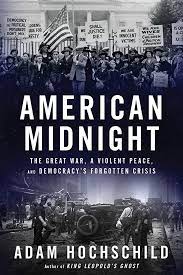
When Wilson Declared War in 1917, America Went Berserk

Shocking and brilliant, this book delves into a period most Americans know little about, the years just after America declared war on Germany, when dark currents in American culture were at a flood tide.  One of the historians the author quotes put it bluntly: “The years from 1917 to 1921 are probably unmatched in American history for popular hysteria, xenophobia, and paranoid suspicion.” 

Pogroms against African-Americans were widespread, with men, women and children being burned alive or stoned to death in East St. Louis as just one horrific episode.  Black soldiers at army bases could be hanged under the false charge of raping a white woman.  Union members were spied on, beaten, arrested without warrants, and imprisoned.  Police forces across the country formed “red squads” to surveil and harass leftists, and the U.S. Justice Department actually encouraged vigilante associations to aid in the terrorizing of American citizens.  

Government and civic officials believed the craziest stories, like the one about Germany sending “gypsy fortunetellers” to Harlem to rile up people against the war.  And Members of Congress broadcast delusional warnings that warned about our border with Mexico–one of which claimed Russian communists were using Japanese submarines to get to Mexico and invade the U.S. to spread chaos.

Newspapers that were perceived as “leftist” or “un-American” were bullied, threatened,  censored, vandalized, or shut down because the out-of-control Postmaster General refused to let them travel through the mails. 

Mainstream newspapers were basically either stenographers, repeating anything they were told to print, or worse, cheer leaders, like The Washington Post noting “In spite of such excesses as lynchings, it is a healthful and wholesome awakening.”

Jury trials were a farce and police did nothing to maintain real law and order, often assisting in the barbaric mayhem which did not shock President Wilson in the slightest.  He cared about the war and his League of Nations plan–mob violence and violence against Black citizens didn’t bother him.  Wilson grew up in the South with slave labor in his household and when you read about him here, you won’t be surprised that as reported in The New Yorker, Princeton students have called for “the school [to] strip the name and imagery of Woodrow Wilson from all of its institutions and buildings.”

The terror didn’t end with the war because it was followed by The Red Scare, which takes up the second half of the book.  Civil rights were pulverized, many hundreds of people arrested without warrants or deported, and machine guns were positioned in city streets to “protect good Americans,” which meant Anglo-Saxons for the most part.

This was a time in which people could be arrested for what we might call “thought crime”: expressing private doubts about the war or criticism of the government.  That could even extend to a judge damning people because he could read what was “in people’s hearts.”  Jury trials were a farce and sentences for supposedly violating the vague, newly-passed Espionage Act were egregiously severe.

America in these years truly sounds like an authoritarian state, with a rampaging government, aided by vigilantes, peering into every nook and canny of its citizens’ lives and punishing any word or deed it thought was subversive. It’s hard not to see similarities with Nazi Germany in the manic propaganda campaign for the war and “patriotism” that bombarded Americans with signs, pamphlets, speeches, and films–and the advice to spy on one’s neighbors.

Hochschild lays all of it out in calm, cool detail that will sear itself into your memory.  This is the kind of book that white-washers of our past would want to ban but which every thinking American should read. 

Lev Raphael is the author of 27 books in genres from memoir to mystery.  He has taught creative writing at Michigan State University and currently edits, coaches, and mentors writers at writewithoutborders.com

Summertime…and the Christie is Breezy

Agatha Christie has been in the news lately along with other authors as someone whose “potentially objectionable” comments about characters needed to be censored for contemporary audiences.  Several of her novels have been rewritten by her publisher, as reported in The Guardian:

[The] edits cut references to ethnicity, such as describing a character as black, Jewish or Gypsy, or a female character’s torso as “of black marble” and a judge’s “Indian temper”, and removed terms such as “Oriental” and the N-word. The word “natives” has also been replaced with the word “local.”

Sure enough, this new collection of short stories seems to mock gay men and has a “fat Jewish woman” and “Asian” is used as a pejorative.  Moments like that might give you pause–or you might just accept them as representative of her time and her class.  Will they spoil your enjoyment of these light summer reads?  I long ago accepted her antisemitism as par for the course in The Gilded Age and in her social milieu.  My appreciation of her work inspired me to write three books including one of my best-known mysteries, The Edith Wharton Murders.

Christie is the first mystery novelist I read way back in junior high school and though she might make me occasionally wince, I’ve always relished her clever plots and her keen attention to incongruity in dialogue and action.  She’s masterful in that regard and often very entertaining.  Her satire of Brits abroad is always delicious, as in “The Oracle at Delphi”:

Mrs. Peters had tried hard to take an interest in Ancient Greece, but she found it difficult.  Their statuary seemed so unfinished; so lacking in heads and arms and legs.  Secretly, she much preferred the handsome marble angel complete with wings which was erected on the late Mr Willard Peters’ tomb.

We of course find Miss Marple here, in the very well-plotted–if not quite believable–tale The Blood-Stained pavement, remarking as usual that “There is a great deal of wickedness in village life.”  Poirot’s little grey cells are keenly at work in a story whose title is perhaps too much of a giveaway, but is diverting anyway: “The Double Clue.”  Poirot also solves a case without leaving his home in “The Disappearance of Mr. Davenheim,” demonstrating the superiority of thought over feeling once again.  But Miss Marple can do something similar elsewhere in the collection, based as always on her keen observation of human nature.

Throughout the collection, the characters are described briskly and the dialogue is well-tuned.  There’s sometimes the whiff of port and cigars shared by an after-dinner raconteur and you might feel you’re enjoyably back in the Edwardian era of a ghost story-telling.  

The best story is the fast-paced and highly amusing “Jane in Search of a Job” about a young women hired under unusual circumstances.  It’s got some lovely twists and tart observations like this:

In moderation Jane did not object to crime. The papers had been full lately of various girl bandits. Jane had seriously thought of becoming one herself if all else failed.

As with other new Christie titles published by Morrow, the book is beautifully produced with a pleasingly readable type font and an attractive cover. Though  Morrow’s volume of ghost stories released last Fall for Halloween is somewhat more entertaining, it’s still a fun, quick read for fans of the Queen of Mystery.

Lev Raphael was the longtime crime fiction reviewer for the Detroit Free Press and is the author of ten Nick Hoffman mysteries set in contemporary academia.

The Grand Affair: A Thrilling Biography of John Singer Sargent

Growing up in Rome in the mid-19th century, John Singer Sargent could not have asked for a better informal education for the world-class artist he would become. He was surrounded by museums overflowing with great art and just as important, his ebullient, energetic American mother hosted gatherings of painters, sculptors, poets and writers. 

Sargent’s mother was obsessed with European culture and may have modeled that enthusiasm for her son.  She also was an inveterate traveler “for her health,” so the family traipsed all over Western and Central Europe with young Sargent watching, studying, sketching–whether in museums or on mountain tops.  It’s fascinating to read about the challenging mountaineering he did in Switzerland with his father, something you might not associate with a man who later spent so much time in salons and studios.

This was a period when living in Europe cost much less than in the U.S. and  Americans like his mother were ravenous for culture of the Old World. Sargent grew up multilingual, voraciously interested in art, and Rome is where he was first exposed to an artistic subject that would be a constant in his life, though somewhat secret: male nudes. 

Whether painter or connoisseur, back then you could appreciate these nudes as the “ideal representation of humanity” without arousing suspicion, but Sargent’s sketches and paintings showed more than just artistic fascination.  Fisher explores this terrain with wit and style, referencing many of Sargent’s sketches and paintings that were unknown during the painter’s lifetime to make this crucial point.   As he puts it, they “stood out as charged, emotional composition.”

Sargent never married and had many deep friendships with male artists and models as long as he lived, while cultivating rich, powerful “iconoclasts and divas” like the famed art collector and Isabella Gardner.  Was he queer?  It seems obvious that he was and that it was part of his unique vision of people which astonished other painters, including tutors and teachers–and eventually made him famous. 

Some of the best writing in the book explores the not-so-hidden gay salons and haunts in Paris, New York, and Venice and how artists, writers, and wealthy men flirted with this subculture or made themselves at home in it. Fisher also deftly explains all the ways in which Sargent often focused on wealth and celebrity in his work while interrogating it as well, with many subtle touches of eroticism.  Fisher couldn’t be a better guide in analyzing paintings: he’s illuminating without ever coming across as academic or dry.

He also deftly analyzes Sargent’s keen business sense: even in his early twenties, Sargent knew how to cultivate wealthy sitters so he could attract more of them and knew what was daring and unique enough to have work publicly displayed.   He did that while remaining in his public persona “understated, hard-working, and self-effacing.” The author does a splendid job charting Sargent’s peripatetic life and the ways in which he presented as comme il faut but was actually innovative and even disruptive in his art, testing the limits of what the public might accept.  That thread is important for contemporary readers who might need some of the painter’s work decoded due to its subtlety.

Given the book’s subject and the gorgeous color plates, it’s strange that the cover is so grim and unappealing.  Fisher’s luscious book deserved better production, something worthy of his subject’s style and genius, worthy of this “painter of luminous complications.”  It also deserved much better copy editing because there are too many missing words and repetitions throughout the book.

All the same, this masterful biography is perfect not just for fans of the painter but for anyone eager to read more about The Gilded Age.  One celebrity after another passes through these pages–including Henry James, Robert Louis Stevenson, Monet, Isabella Gardner–and Fisher ably interrogates the privilege that artists like Sargent benefited from, without sounding like too much of a scold.

Be prepared to spend some time on Google looking up paintings and painters you might not have heard of before. And readers might also want to try Donna Lucey’s brisk and entertaining Sargent’s Women which explores the colorful biographies of the women behind four of his iconic portraits.

A lifelong fan of vivid biographies, Lev Raphael fell in love with Sargent’s portraits in college.  One of the most enthralling exhibitions he’s ever attended was the mammoth 1987 show of the painter’s work at the Art Institute of Chicago.  Raphael has reviewed books for Bibliobuffet, The Detroit Free Press, Jerusalem Report, The Washington Post, and The Ft. Worth Star-Telegram.

Blood, Fire, & Gold

Even if you’ve read a dozen books about Elizabeth I, you might enjoy this study of the Tudor queen and her decades-long rival Catherine de Medici, Queen of France for over a decade and Queen Mother to Francis II, Charles IX, and Henry III.  The two most powerful women in sixteenth-century Europe, both queens were highly educated and masterful stateswomen.  They learned while young how to navigate dangerous royal courts and religious turmoil, how to stay strong but outwardly pliant when necessary, and how to deal with demanding, powerful men in a world where they would be in the minority as women of power.  Both survived dizzying plots, war, and shifting allegiances “while enemies hid around every corner.” 

The dual biography deftly charts the twisting European alliances that could shift with a marriage as well as a treaty or just the threat of war, and demonstrates what excellent politicians both queens were as they maintained and expanded their power.   Mary Queen of Scots is the perennial wild card for each queen, and the book’s best surprise is its focus  on the fascinating trials and tribulations of an English ambassador to France, Sir Nicolas Throckmorton, who frequently begged to be released from his dangerous and demanding post but was unafraid to speak plainly to the Queen Mother.  

I wish the book had been more thoroughly copy edited.   That would have eliminated readers being told three times in a short space that Thomas Cramner was Archbishop of Canterbury and that Frances II was nine years old two paragraphs apart.  Or having to look up the translation of the French title of a religious work that Elizabeth gave us a gift even though it was highly controversial in France. Paranque says nothing at all about the controversy.  And good copy editing would have eliminated repetitious diction as well as odd phrasing like  “appease tensions” in place of “ease tensions.”  Some long conversations during negotiations between England and France could also have been summarized.

Paranque is no Alison Weir, Leanda de Lisle or Dan Jones, and the book doesn’t quite live up to the jazzy title.  But there are some good stories here, like the gruesome joust that wounded France’s King Henry II, Catherine’s husband, and led to his miserable death.  The intervention of a famed surgeon is an unforgettable classic of bizarre medical practice in that period.   Even more fascinating is elderly Elizabeth’s interview with a French envoy, dripping with jewels in her gorgeous dressing gown, bosom exposed, a picture of sad ruin and abiding grace.

Lev Raphael has been reading about the Tudors since elementary school. He has reviewed books for The Washington Post, The Detroit Free Press, Jerusalem Report and three public radio stations.  He hosted an interview show where guests included Salman Rushdie and Erica Jong.